
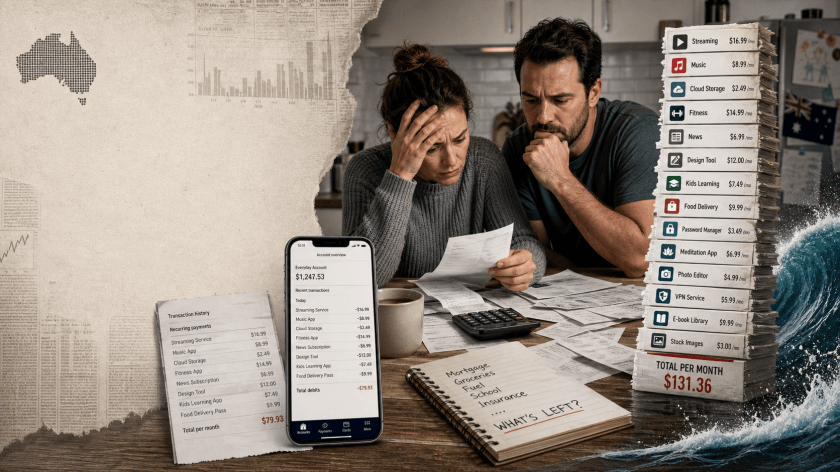
Subscription Creep: The Silent Financial Killer
It starts with a single sign-up. A Netflix account for weekend viewing. Spotify for the daily commute. Perhaps Stan for local content or Kayo for sport. None of it feels excessive. Each service costs less than an UberEats meal. But over time, these small, recurring payments accumulate into something far more consequential.
Welcome to the era of “subscription creep”, a quiet but persistent drain on household finances that is becoming increasingly common across Australia.
The Rise of the Subscription Economy
Australia has enthusiastically embraced the global shift toward subscription-based services. From entertainment and software to meal kits and fitness apps, recurring payments are now embedded in everyday life.
Streaming alone illustrates the trend. Many households now juggle multiple platforms each offering exclusive content: Netflix, Stan, Disney+, Amazon Prime Video, Binge. Add Spotify or Apple Music, cloud storage through Google or Apple, and perhaps a subscription to The Australian or the AFR, and the monthly tally begins to grow.
What makes these costs deceptively manageable is their size. A $10 or $15 monthly fee feels insignificant in isolation. But the maths tells a different story. Ten subscriptions quickly approach $150 per month; that’s nearly $1,800 per year.
The Hidden Cost of Convenience
The real danger of subscription creep lies in how easily it escapes attention. Unlike rent, groceries or petrol, subscription payments are automated and dispersed. They appear as small line items on bank or credit card statements, often going unnoticed.
In Australia, where contactless payments and digital wallets are widespread, this invisibility is amplified. There is no physical exchange, no moment of hesitation. The transaction simply happens.
Research into consumer behaviour consistently shows that people underestimate recurring expenses. When asked to estimate their total subscription spend, most fall well short of the actual figure. The result is a slow but steady erosion of disposable income.
For households already facing rising living costs, from higher mortgage repayments to increasing energy bills, this unnoticed leakage can matter more than it seems.
Signs You Might Have a Subscription Problem
Subscription creep does not arrive with a warning. It builds gradually, often slipping under the radar. However, several indicators suggest it may be taking hold:
- You cannot confidently list all your subscriptions without checking your bank app.
- You are paying for services like Kayo or Stan that you have not used in weeks.
- You maintain multiple streaming platforms despite only watching one regularly.
- Free trials have quietly rolled into paid subscriptions.
- You notice unfamiliar or unexpected charges on your monthly statement.
- Your discretionary spending feels higher than expected, but you cannot clearly identify why.
A particularly common Australian example is seasonal subscriptions. It’s easy to sign up to Kayo for the AFL or NRL season, then forget to cancel once the grand final celebrations are just a nasty hangover.
How Much Are Australians Spending on Subscriptions?
Pinning down the exact cost of subscriptions is surprisingly difficult, precisely because many consumers underestimate or overlook them. However, recent surveys and banking data suggest the average Australian is spending more than they realise.
Estimates indicate that Australians spend between $80 and $150 per month on subscription services, with higher-income households often exceeding $200. This includes streaming platforms such as Netflix, Stan and Disney+, as well as music services, cloud storage, gaming subscriptions and digital news.
Streaming remains the largest category. A household subscribing to three major platforms can easily spend $40 to $70 per month on entertainment alone. Add Spotify ($12–$15), cloud storage ($3–$15), and a fitness or productivity app, and the total quickly escalates.
Younger Australians tend to have more subscriptions but lower overall spend, while older households often carry fewer subscriptions but higher-value services, such as premium news or bundled digital packages.
Perhaps the most revealing figure is this: when asked to estimate their subscription spending, most Australians understate the total by 30% to 50%.
The takeaway is simple. Subscription costs are not necessarily high, but they are persistent, cumulative and often underestimated.
Why Subscriptions Are So Hard to Cancel
If subscriptions are easy to accumulate, they are often harder to eliminate.
Signing up typically takes minutes. Cancelling, on the other hand, can involve navigating account settings, remembering passwords or dealing with retention prompts offering discounts or paused memberships.
There is also a psychological hurdle. Many consumers keep subscriptions “just in case”. A streaming service might not have been used recently, but the possibility of watching a new release next weekend justifies keeping it active.
This behaviour reflects a mix of inertia and optimism. People overestimate their future usage and underestimate the cumulative cost of maintaining multiple services.
Taking Back Control
The first step in addressing subscription creep is visibility.
Start with a subscription audit. Review your bank or credit card transactions over the past three months. Most Australian banking apps make this relatively straightforward. Identify all recurring charges and calculate your total monthly spend.
Next, assess value. For each subscription, ask: would I sign up for this today at its current price? If not, it is a strong candidate for cancellation.
Consider consolidating services. Instead of maintaining several streaming platforms simultaneously, rotate them. Subscribe to one for a month, watch the content you want, then switch. This approach is particularly effective given the fragmented nature of streaming libraries in Australia.
You can also introduce deliberate friction. Turn off auto-renewals where possible or set calendar reminders before billing dates. Some consumers go further by using a separate debit card for subscriptions, making the total cost more visible.
Finally, establish a subscription budget. Treat subscriptions as a defined category within your monthly expenses, rather than an open-ended collection of small charges.
A Modern Financial Discipline
Subscription creep is not the result of poor financial habits so much as a structural shift in how spending occurs. As payments become more seamless, managing them requires greater intentionality.
In the Australian context, where cost-of-living pressures remain a central concern, even modest savings can make a difference. Eliminating $50 to $100 per month in unused subscriptions may not seem transformative, but over a year it represents a meaningful sum; money that could be redirected toward savings, investments or simply easing financial stress.
The broader lesson is clear. Convenience has a cost, and increasingly, that cost is recurring. The subscription services know this and sneakily encourage us to join their game.
In a world of frictionless payments and on-demand services, the challenge is no longer access. It is awareness. And for many Australians, regaining that awareness may be one of the simplest ways to improve their financial position.
 The Money Question
There’s a way you may be able to cut subscription expenses by 70%-80%, I live in Australia but have a digital wallet with Indian rupees, what I do is I put my VPN address and Google store address to India and get the same subscriptions by paying a fraction of the price. Example: Netflix subscription in India costs equivalent to 2.5 dollars a month instead of 20 dollars.
LikeLike