
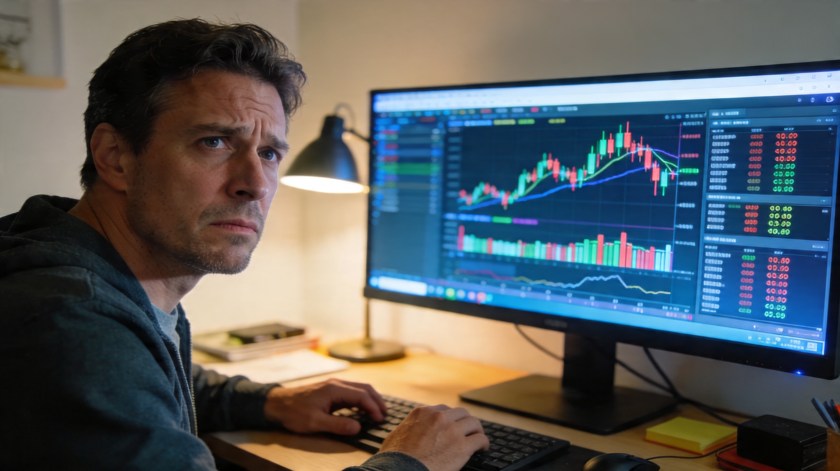
Why Novice Investors Should Be Wary of Day Trading
Day trading has long been sold as the fast lane to financial freedom. Social media clips show traders celebrating quick wins, turning a few clicks into easy money and supposedly beating the market before lunch. For novice investors, that story is dangerously misleading. In reality, day trading is a high‑risk, high‑stress activity that most beginners fail to master, while passive, diversified investing offers a far more reliable route to wealth. Evidence from the Australian market reinforces this: regulators, exchanges and industry‑written guidance all warn that most retail day traders are unlikely to profit and that trading is far harder than it looks.
What day trading really is
Day trading means buying and selling stocks, or other securities, within the same trading day. The goal is to profit from small price swings, not from the long‑term growth of companies. In theory, that sounds simple. In practice, prices move for reasons that are hard to predict, trading costs eat into gains, and losses can compound quickly. The Australian Securities Exchange (ASX) explicitly warns that day trading is “the hardest way to make an easy living” and that many who try it full‑time fail to achieve consistent results.
Day trading is not investing in the traditional sense. A long‑term investor buys a diversified portfolio and earns returns from the growth of businesses over years and decades. A day trader is trying to extract tiny gains from short‑lived price changes, often while competing against professionals, algorithms and faster market participants. That contest is fierce, expensive and unforgiving and it is especially difficult for Australians using the ASX, which is smaller and more volatile than many global markets.
Australian evidence that day trading is hazardous
The Australian context does not hide the risks. An ASX‑authored “Pros and cons of day trading” article stresses that lack of discipline, poor risk management, overtrading and leverage are the main reasons traders fail. The article explicitly notes that many aspirants underestimate the emotional energy and discipline required and that day trading is an occupation where “many are called, but few are chosen.”
A separate ASX “Diary of a Day Trader” feature profiles Austin Mitchum, a professional equity trader at Propex Derivatives who trades Australian shares for a living. He describes day trading as akin to professional sport: behind the apparent wins are years of training, discipline and sacrifice. Even among the best professionals, he notes that a win rate of about 55% is considered strong and that most annual profits come from a small number of high‑conviction trades. For retail traders without that level of training and discipline, hitting consistent profitability is extremely difficult.
Australian educational and broker‑orientated guides reinforce the same message: reputable sources commonly state that less than 10% of day traders are profitable and that around 90–95% of retail traders lose money after costs and tax. When combined with the ASX‑authored caveats, this paints a clear picture: day trading is not a profitable pursuit for most people in Australia either.
Why Australian novices struggle so much
Novice Australian investors usually face several disadvantages at once. First, they overestimate their ability to read markets and interpret short‑term price moves. The ASX notes that traders often chase losses or over‑trade, which erodes capital quickly. Second, they may trade with “scared capital”, that is, money needed for rent, bills or living expenses, which makes it harder to stick to a disciplined strategy when losses occur.
Third, many Australian retail traders use leverage or margin products, which magnify both gains and losses. The ASX explicitly warns that overleveraging and poor risk management are primary reasons traders fail. Fourth, the Australian market is smaller and more concentrated than larger global markets, so liquidity and volatility can make intraday trading more challenging and more dangerous for inexperienced participants.
The power of passive investing in Australia
By contrast, passive, well‑diversified investing offers a much more practical route for Australian novices. Low‑cost index funds and ETFs listed on or tracking the ASX spread risk across many companies and sectors, keep fees low and remove the pressure to predict short‑term moves. Instead of trying to win every day, the investor participates in the market’s long‑term growth. That is a far more realistic strategy for building wealth in an Australian context.
Australian and global research both show that most active strategies, even professional ones, fail to beat broad market indices over time. Passive investing does not rely on timing or intraday skill; it relies on time in the market, diversification and low friction costs. For Australian investors, this means buying into diversified portfolios such as broad S&P/ASX 200 or global index ETFs and holding them through normal market volatility.
A simple comparison: trading vs investing in Australia
A simple Australian‑based illustration underlines the contrast. Suppose one novice tries to day trade ASX stocks with $10,000, pays brokerage, bid–ask spreads and possibly margin costs and takes a series of small losses. Another novice invests $10,000 into a low‑cost diversified ASX or global index ETF and adds a fixed amount every month. Over time, the second investor benefits from compounding, diversification and lower trading friction, while the first investor is fighting for tiny edges in a competitive, high‑cost environment.
This is why speculative day trading is not a reliable path to wealth creation for Australian investors. The ASX guidance and Australian‑market commentary consistently show that most retail day traders are unlikely to profit, while long‑term, diversified investing offers a far more credible route to financial goals.
A better strategy for Australian beginners
For novice Australian investors, the lesson is simple: resist the temptation to chase excitement. Build a portfolio around diversified, low‑cost index funds or ETFs, invest regularly and use time as your advantage. Day trading may promise thrills, but passive investing offers something much more valuable: a clear, evidence‑based chance of actually reaching your financial goals over the long term.

