
A recent survey found that people don’t understand bonds. Let’s try to remedy that.
In the world of finance, bonds from stable governments are regarded as a bedrock of stability and security. These financial instruments provide a reliable avenue for borrowing and investing. But how exactly do government bonds work? A recent survey from investment manager Natixis found that 64% of Australian investors didn’t know what effect rising interest rates had on a bond. That’s actually not surprising since bond mathematics can be quite difficult to understand.
In this article, we will explore the fundamental mechanics of bonds, including coupons, principal repayment, present value and the effect of interest rate changes. We will also touch upon the concept of duration, a key measure of a bond’s sensitivity to interest rate fluctuations.
At its core, a government bond is essentially an IOU issued by a national government. When a government needs to borrow money to finance its operations, infrastructure projects or other expenditures, it can issue bonds to the public or institutional investors. Each bond represents a contractual obligation between the government and the bondholder. Bonds, like all loans, have a fixed lifetime. As at June 2023, the Australian federal government had $823 billion of bonds on issue.
One of the key features of government bonds is the coupon. The coupon refers to the regular interest payment that the bondholder receives over the life of the bond. These interest payments amounts are typically fixed and paid semi-annually. For example, a $1,000 bond with a 5% coupon would provide the bondholder with $50 in interest income every year: $25 every six months. The coupon is an interest payment to compensate the bondholder for lending them money. When the bond matures, the government repays the bondholder the face value of the bond. In our example, the bondholder would receive the initial investment of $1,000 when the bond reaches maturity. The combination of the price paid at the start, coupon payments and the principal repayment determines the overall return on investment for the bondholder. The diagram below represent the cash payments for a $1,000 face value, five year bond with a 5% annual coupon paid every six months. Note that the principal is repaid with the final principal repayment.

The present value of a government bond is an essential concept to understand, as it represents the value today — or the price — of the bond. Present value is the current worth of the future cash flows generated by the bond, taking into account the time value of money. We have discussed present value in a previous article. In simple terms, present value allows investors to determine how much a bond is worth today, given its future cash flows and prevailing interest rates. As interest rates rise, the present value of a bond decreases because higher interest rates make future cash flows less valuable in today’s terms. Conversely, when interest rates fall, the present value of a bond increases. This is shown in the diagram below which calculates the present value of each of the $25 coupons and our $1,000 principal at various interest rates. The value of the bond today is the sum of all of these present values. At 5% interest our bond is worth $1,000 today. If interest rates rose to 6% our bond value falls to $957.35; if interest rates fell to 4% our bond is worth $1,044.91 today. This is how bond prices change in response to changes in interest rates.
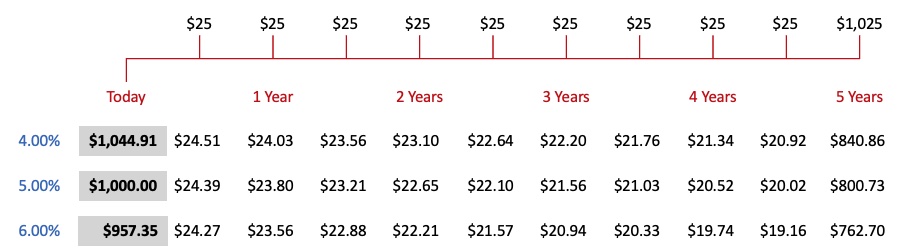
Importantly, no matter what happens to interest rates over the life of the bond we still receive the $25 coupon payments every six months, and our final coupon plus interest at maturity (here we are assuming that the borrower does not go broke, which is a fair assumption if it’s a stable government) . It’s only the present value of these cashflows that changes.
Interest rate rises have a direct impact on the value of existing government bonds. When interest rates in the market rise, newly-issued bonds start offering higher coupon payments, making them more attractive to investors. Consequently, the value of existing bonds with lower coupon rates decreases since their fixed coupon payments become less appealing relative to new bond issues. This inverse relationship between interest rates and bond values highlights the importance of timing and market conditions when investing in government bonds.
Bond market professionals refer to a concept called Duration which is a measure that helps them gauge a bond’s sensitivity to interest rate changes. It takes into account both the time to maturity and the bond’s coupon rate. Bonds with longer durations are more sensitive to interest rate fluctuations. For example, a bond with a duration of five years would be expected to experience a 5% decrease in value if interest rates rise by 1%. Duration serves as a useful tool for investors to manage their bond portfolios and understand the potential impact of interest rate movements.
Investments in bonds can form a solid foundation for an investment portfolio, especially for investors who require regular income, because bonds from stable governments are considered to be guaranteed to make their coupon and principal payments. This is why diversified portfolios usually have an allocation to bonds. For those in retirement allocations to bonds can form a reliable income stream.
In conclusion, government bonds play a vital role in financial markets by providing governments with a means to raise capital. Understanding the mechanics of government bonds, including coupons, principal repayment, and present value, is crucial for investors. Additionally, the relationship between interest rates and bond values highlights the importance of keeping a close eye on market conditions. By considering duration, investors can assess a bond’s sensitivity to interest rate changes. Overall, government bonds offer a secure investment option for individuals and institutions seeking reliable returns with manageable risks.
 The Money Question