
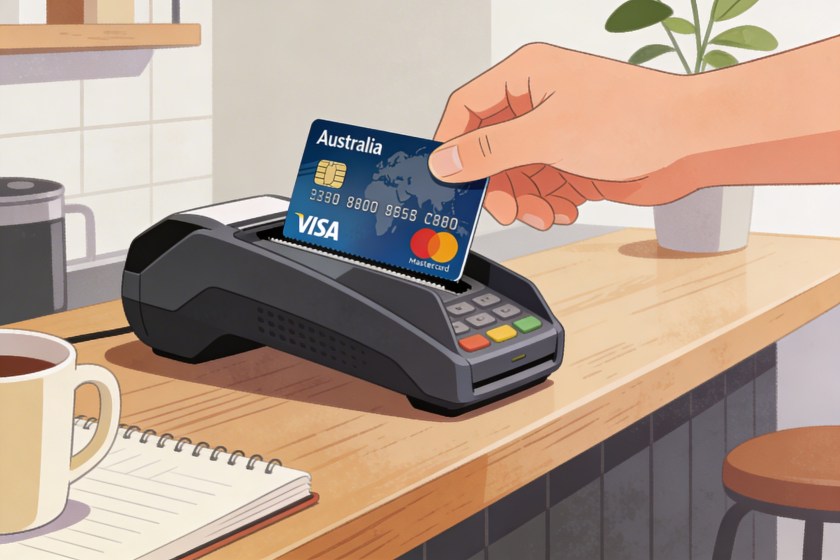
If you’ve ever paid for groceries, a train ticket or a restaurant bill with a card, you’ve almost certainly paid an invisible tax. It’s not listed on the receipt, and it may not even show up on your bank statement. But somewhere in the background, money has changed hands between banks, networks, and merchants. That money is the interchange fee: the engine that powers the card‑payment system, and the bullseye of the Reserve Bank of Australia’s latest reform.
In October 2026, the RBA will ban merchants from adding explicit surcharges to debit and credit‑card transactions. At the same time, it will cap interchange fees even more tightly. The result is a quiet but profound shift in who pays for the convenience of card payments, and how much of the cost we, as consumers, can see. To understand what this means, we first need to pull back the curtain on interchange fees themselves.
What is an interchange fee?
Imagine you’re at a café, and you pay with your Visa credit card. On the surface, it’s simple: you hand over the card, the machine beeps and you’re done. But behind that tap is a mini‑marketplace of banks and networks.
An interchange fee is the wholesale price the café’s bank pays to your bank for the right to charge your card account. It’s not a fee the cardholder sees directly; it’s buried in the economics of the transaction. Yet it is the central lever that determines how much merchants dislike accepting cards, how generous banks can be with rewards and how much the system costs overall.
Here’s what happens, step by step:
- You tap, insert, or swipe your card.
- The café’s acquirer (its merchant bank or payment provider) sends the transaction through a card network (Visa, Mastercard, or eftpos) to the issuer (the bank that issued your card).
- The issuer checks whether the card is valid, whether you have enough credit and whether the transaction looks suspicious.
- If approved, the network routes the approval back to the café.
- Later, the banks settle the money: the issuer tells the network, the network tells the acquirer and the acquirer credits the merchant’s bank account minus its fees.
The interchange fee is the slice that the acquirer pays to the issuer through this chain. It is not the total fee merchants pay; it is the core wholesale cost that sits under the merchant service fee you see if you run a business.
How the network splits the economics
If you imagine the card‑payment system as a pipeline, three main players are in the middle:
- The issuer (your bank) funds the transaction, bears the risk of default and fraud, and services the cardholder.
- The acquirer (the merchant’s bank) underwrites the merchant, manages the card‑acceptance infrastructure, and settles funds.
- The card scheme (Visa, Mastercard, eftpos) runs the rails and collects scheme fees from both sides.
A typical flow looks like this:
- Your bank (issuer) pays the interchange fee into the system.
- The acquirer may pay a small fee to the card network for carrying the transaction.
- The merchant’s bank passes all of this forward to the merchant as part of its merchant service fee.
In practice, the merchant does not see a line item called “interchange.” They see one or two bullet‑points: “card‑acceptance fee” or “merchant discount rate.” Those aggregates are the sum of interchange, scheme fees and the acquirer’s margin. The more credit‑card‑heavy a merchant’s traffic is, and the more premium cards their customers hold, the higher those fees become.
So why did the RBA cap and effectively “scrap” interchange?
For economists and central bankers, interchange fees are a classic pricing‑and‑incentive problem. Issuers like them because they are a steady source of revenue. Merchants dislike them because they eat into already thin margins. Consumers are mostly unaware of the mechanics, but not unaware of the consequences when they see a 1–2% surcharge at the checkout or when their card rewards get richer every year.
Australia has long regulated interchange, but the RBA’s 2026 decision is the most aggressive yet. The central bank has:
- Capped interchange more tightly on debit and consumer credit cards.
- Banned explicit surcharges that merchants used to pass these fees on to customers.
- Tightened how merchants can disclose and justify any residual card‑cost pass‑through.
The goal is transparency and fairness. The RBA fears that:
- Surcharge‑heavy sectors (airlines, taxis, some online services) overcharge thin‑margin sectors (corner stores, cafes).
- Reward‑card users enjoy a “free” benefit financed by the extra cost merchants pay for card acceptance.
- The true cost of card payments is hidden from consumers, undermining competition and rational choice.
In effect, the RBA is saying: if the system is going to be expensive, the price should be open, not disguised as a fee layered on top of the sticker price. By capping interchange and banning surcharges, the central bank is trying to shift the incidence of card‑costs closer to where consumers can see them: at the headline price.
Where the cost used to hide and where it hides now
Before the RBA’s move, interchange‑driven costs showed up in three main places:
- Explicit surcharges: At the checkout, retailers would add 0.5–2% for “credit card processing.”
- Reward‑card perks: Free flights, points, lounges and cashback were funded, in part, by the extra margin on card‑acceptance fees.
- General pricing: Some merchants baked card‑acceptance costs into their base prices anyway, especially where surcharges were not allowed or not practical.
After the reform, the map changes:
- Surcharges disappear from the till. The quoted price is the final price.
- Interchange shrinks even more, squeezing the reward‑card model.
- Some of the cost must still be paid, so it either:
- Sits in the merchant’s margin, or
- Creeps into headline prices, especially for businesses that previously relied heavily on surcharges.
What the RBA is really doing is changing the visibility of the cost, not eliminating it. The system is still expensive, but the bill is no longer itemised at the bottom of the receipt; it is folded into the top‑line price you see on the menu or the website.
The winners and losers
Any reform of this kind creates winners and losers. The RBA estimates that eliminating surcharges will save consumers around $1.6–1.8 billion per year in explicit fees. That is the headline win. Yet the full picture is more nuanced.
Who wins
- Consumers paying by card: The most obvious beneficiaries. No more “surprise” fees at the checkout, and arguably more transparent pricing.
- Large merchants with strong pricing power: They already had the strongest card‑cost deals with banks. Tighter caps and clearer rules reduce the over‑pricing that flowed from small merchants to large ones.
- Payment‑service transparency: The RBA hopes that bundling interchange tightly will make it easier for businesses to compare acquirers, processors and gateways, driving competition.
Who loses or faces pressure
- Merchants previously reliant on surcharges: Small businesses and high‑unit‑cost sectors (e.g., airlines, taxis, some hospitality) lose a tool to recover card‑acceptance costs. They must either absorb the cost, reduce margins or raise prices.
- Card‑issuing banks: The RBA’s cap on interchange and the end of surcharges both compress the revenue pool that banks use to fund card‑related activities.
- Reward‑card programs: This is the most visible consequence. The generous points, cashback and travel benefits were cross‑subsidised by interchange‑driven margins. With those margins shrinking, programs are expected to:
- Reduce the value of points earned per dollar spent.
- Introduce or raise annual fees.
- Scale back premium perks (lounges, travel credits, concierge).
In other words, the “free” travel‑card lifestyle becomes less free. The reform is effectively unwinding a cross‑subsidy that ran from cash‑paying and low‑margin merchants to credit‑card‑using, reward‑seeking consumers. Those who enjoyed that subsidy lose some of their privilege; those who bore the burden gain a break on explicit fees.
Why debit cards are different
One of the quirks of the Australian system is that debit cards look like they “don’t cost anything.” Many consumers assume that paying with a debit card or an eftpos‑linked card leaves the merchant entirely free of fees. The truth is a bit subtler.
Debit cards still generate a small interchange fee, but it is:
- Capped by the RBA at a few cents per transaction or a small percentage (around 0.16% of value, with a cap on the cent‑amount), so the fee is negligible for most purchases.
- Structured so that the risk and funding cost are low; the money comes from the cardholder’s own account, not the bank’s balance sheet.
- Often treated as effectively zero in certain eftpos‑only scenarios, where the network is designed to move only small amounts of real‑time money with minimal markup.
Debit cards, in short, are the “utility” of the payment world: cheap, low‑risk, and regulated aggressively so that the cost to the merchant and, indirectly, to the consumer is as small as possible. That is why the RBA’s reforms focus so heavily on credit‑card interchange and surcharges, where the distortion was largest.
The broader economic story: regulation, risk, and transparency
Behind the jargon of interchange, schemes, acquirers and issuers lies a simple idea: card payments are a service, and the cost of that service has to be paid by someone. The question is not whether the system should be free—it cannot be—but who should bear those costs, and how visible they should be.
Interchange fees are the price of several services at once:
- The issuer’s willingness to lend consumers money (in credit‑card cases).
- The acquirer’s willingness to underwrite and settle the merchant.
- The card network’s willingness to run the rails, enforce rules and handle disputes.
In Australia, the RBA has long played the role of referee, nudging that price downwards when it believes costs are excessive or hidden. The latest reforms are the most confrontational version yet: the central bank is effectively saying that the “hidden rent” from interchange‑based reward‑card economics and opaque surcharges has gone too far. It is forcing that rent into the light, embedded in the prices we see every day.
What this means for you at the checkout
For the ordinary consumer, the practical impact is straightforward:
- You will see fewer extra fees at the till when you tap your card.
- The headline price on the menu, the website or the supermarket shelf will be closer to the final price you pay, and may increase slightly.
- Your credit‑card rewards may feel less generous over time, as the cross‑subsidy from merchants and non‑card users fades.
- Debit cards will remain your cheapest, least‑controversial payment method, because the regulatory and economic incentives are aligned to keep their cost low.
If you like to think in diagrams, imagine the old world as a two‑layer cake:
- The bottom layer: the sticker price.
- The top layer: the surcharge, funded by interchange and poorly understood by consumers.
The RBA’s move is to flatten the cake. The top layer is either removed or folded into the base. The total cost may not fall much, but the shape of the bill has changed—and, in the central bank’s view, that is the more important part of the reform.
In the end, the story of interchange fees and the RBA’s decision to cap and effectively “scrap” them is a story about who pays how much for convenience, and how much they get to see it. It is a classic case of financial regulation hiding in plain sight, quietly reshaping the way you pay and what you get for it.
 The Money Question